

Why Emily Can't Speak French
What Emily in Paris can teach you about learning French

Throughout the five seasons of Emily in Paris, viewers have to try to sympathise with Emily who still hasn’t managed to speak French after all that time. Unfortunately, that’s the only realistic part of the show, unlike her ever-expanding expensive wardrobe…
In season 5, Emily still can’t order bread at a boulangerie. She says:
Merci madame Bernard! Quand je suis dans Rome, ton pain je manque moi!
If Emily was trying to speak English, it would sound like this (my translation):
Thanks Mrs Bernard! What I am in the Rome, your bread me miss, dude!
I added the “dude” because she also hasn’t learned the use of vous, so it would sound that level of informality for French people!
Ok, I believe the writers of this show exaggerated how many mistakes one can make in a single sentence, but the truth is that it’s quite common for many people to live in a country for several years and later go back home and feel a little ashamed when their friends and family ask you, “So, your French must be pretty fluent by now?”
Well…
Why Emily never got past the beginner’s level

Let’s take a look at some common reasons why Emily (and obviously many other people like her) get stuck at the beginner stage in French.
But first, let’s set something straight:
The beginner level is, by definition, the easiest to complete!
In language learning, each level becomes progressively more challenging.
This is why we often talk about the intermediate plateau.
Subscribe to receive the free newsletter.
Upgrade to access members-only content and full lessons.
What is the intermediate plateau?
It’s the very real challenge that many language learners face when trying to move from an intermediate to an advanced level.
Many learners feel stuck at the intermediate level for years.
Interestingly, we don’t often talk about a beginner’s plateau.
The beginner’s plateau is not really a “plateau.” It’s what happens when you never get properly started, when you never manage to learn the basics in order to get to a functional level in the language.
However, with the right guidance, getting past the beginner stage shouldn’t be a problem for anyone.
If you haven’t, it may be due to one of the following reasons.
Emily tried the “lazy” method with an app
Many French learners look for an easy solution to master conversational French.
That’s what Emily does in the show, trying to learn basic greetings on an app on the plane to Paris. She even admits to her new boss that she tried Rosetta Stone on the plane, but “it hasn’t kicked in yet.”
I know, I know… some of you love Duolingo, Rosetta Stone, and other language-learning apps.
But hear me out.
When I was teaching as a private tutor, I noticed a strange pattern. Every time a new student told me they had been using a language-learning app for several months, their level was almost indistinguishable from someone who had done absolutely nothing in that time frame.
In other words, there wasn’t much difference between those who said, “I spent three months on Duolingo,” and those who admitted, “I just started last week.”
Curious about the hype, I decided to try Duolingo myself. Honestly, I wasn’t impressed. The material lacks logical progression, and language learning is about more than just memorizing words and phrases — it’s also about understanding culture and context, which these apps don’t integrate well.
Not to mention, learning on a smartphone isn’t particularly effective for the obvious reason that smartphones are a constant source of distractions.
I’d have much more to say about this but I’ll move on for now…
Emily is not speaking French (when she could)
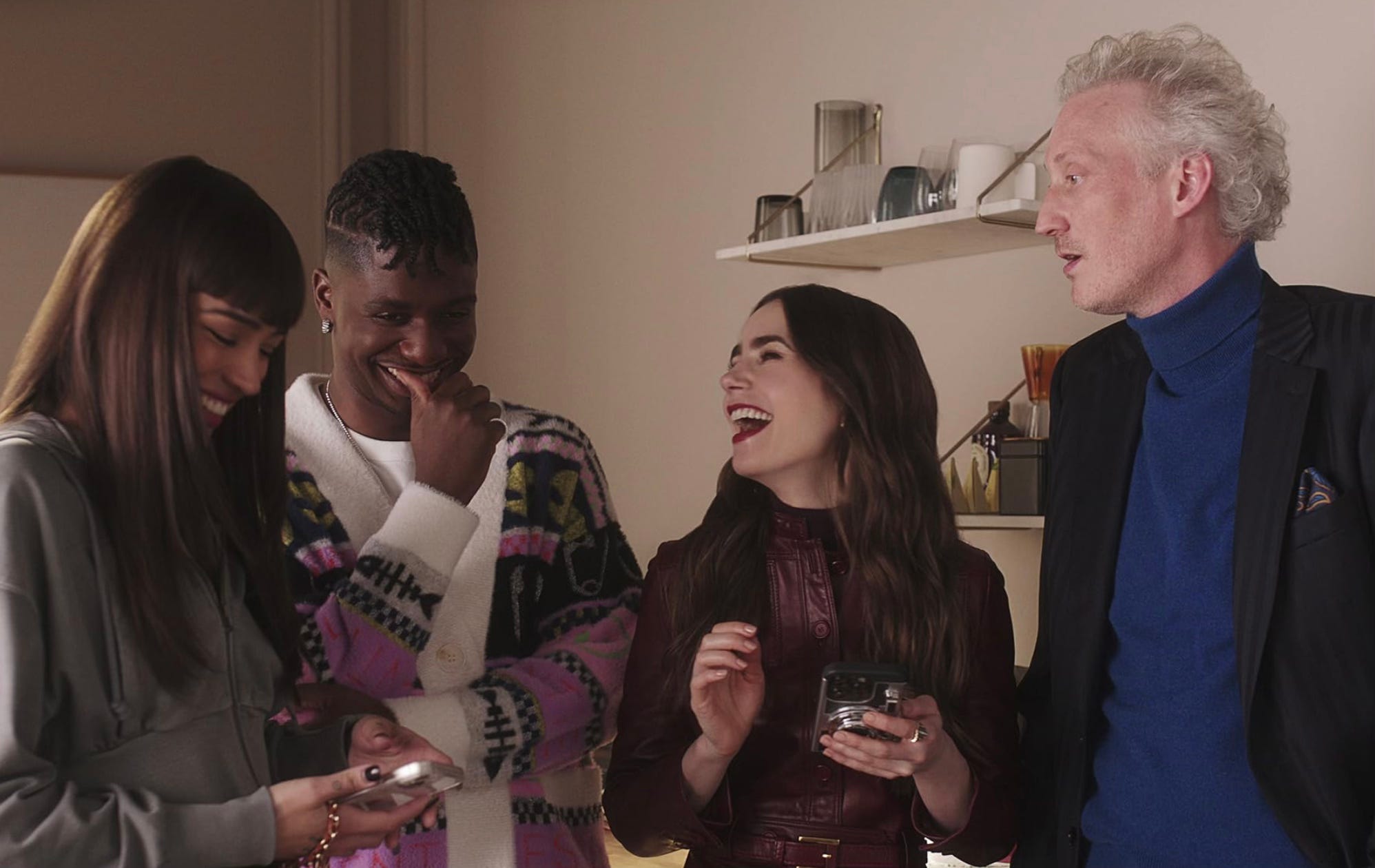
Throughout Emily in Paris, Emily is relying on English constantly, and rarely makes a real attempt at speaking French.
She even uses Google Translate to get by, which leads to embarrassing mix-ups with false friends, like the time she ordered a croissant “avec le préservatif” thinking she was asking for jam, but she instead asked for a condom.
If she did not speak English and only spoke Spanish, for example, she would have been forced to speak French.
In other words, every time Emily is speaking English in Paris, she’s actively not learning French. She’s doing the opposite of what she needs to learn French.
It might sound obvious, but to learn French you need to speak it!
Yet, I see too many people not speaking it when they can, reverting to the comfort of speaking English.
If your French isn’t fluent, know that it will never get any better if you don’t go out there and speak it, knowing full well you’ll make lots of mistakes along the way.
Emily is not reading in French
Emily tries to learn French with apps, by casually asking people how to say certain things, and by attending classes with other expats.
She’s missing out on the most powerful way to acquire vocabulary: reading.
If you find it too difficult to read in French, start small, with 10-15 minutes a day. Find something you really want to read and look up a maximum of 4-5 words per page.
At first, it will seem like you’re not making much progress. But reading accumulates over time, and your vocabulary will only increase.
Emily is not in love with French!

Emily obviously loves Paris and France, as well as super handsome (and extremely bilingual) Frenchmen, but she doesn’t seem to be in love with the French language, or have a burning desire to learn it.
She knows that her life would be better if she spoke French, but she’s not obsessed about learning French.
And in order to learn a language, you need to be a little obsessed.
Emily lacks the necessary curiosity that would lead her through the process of wonder and discovery that is language learning.
Some learners focus solely on language without exploring the culture. But language is inseparable from culture.
Emily should watch movies and TV shows, read novels, non-fiction, and newspapers, visit museums, explore history, attend theater performances, and watch documentaries.
She should and you should immerse yourself in culture to truly learn the language!
Emily needs a vision
Emily is a fictional character. But there are many people like her who can’t find the motivation to learn French even though they know it’s something that could benefit their lives.
They lack a vision.
A vision is the mental image you hold in your head when you imagine yourself speaking French fluently.
For example, you could set specific goals for yourself.
Being able to read a book you’ve always wanted to read in French.
Being able to understand a movie you love.
Being able to speak French with someone you know.
This vision is necessary because it is your source of motivation. No one is motivated by reaching a level on paper (B1, B2, etc.). We need concrete motivation!
The more you focus on the vision rather than on “learning,” the more you’re going to be motivated to continue and invest more time into it.
Learn French because you want to watch great movies, rather than watching boring movies to practice your French.
Learn French because you want to participate in stimulating conversations, rather than doing dry exercises to try to speak better French.
Read in French because there’s a book you really want to read in the original language, rather than just reading because you want to “improve your vocabulary.”
Learning French should be viewed as the key to a door that gives you access to new friends, interesting conversations, great books, great movies and great culture.
If you change your mindset to focus more on the process, you might just start to make more progress!
Vas-y Emily, you can do it!

Émily est la "Girl next door' qui fait rêver et qui rassure l' ignorant moyen USA sur le fait que partout dans le monde l'anglais règne et domine.
Soulagé, je suppose 😅?!